Cyclopædia
Assuming degree is required, the following 81 results were found.
-
AIRhttps://chambers.encyclo.eu/index.php/physics/AIR
has all the Properties of Air; and whether such Air is not transient, as well as that from humid ones; though not to that degree. Mr. Boyle argues, from an Experiment made in the Air-Pump with a lighted Match; that those light and subtle Fumes into...
- Type: Article
- Author: Ephraïm Chambers
- Category: Physics
-
THE PREFACEhttps://chambers.encyclo.eu/index.php/preface
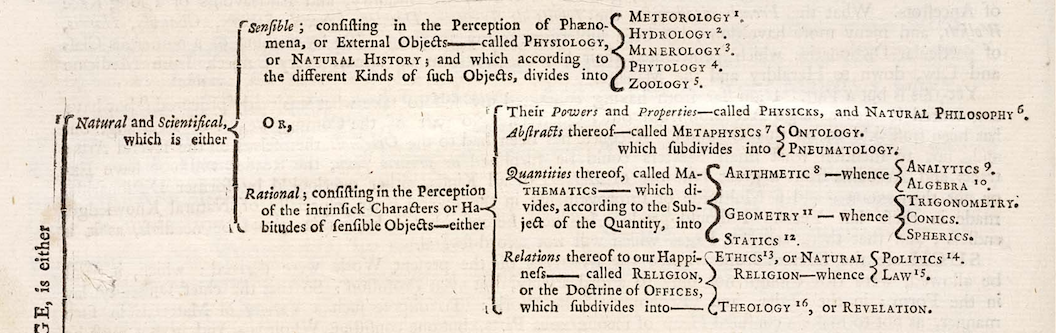
Censure for engaging in it, even disadvantageously; and whether to have fail'd in so noble a Design, may not be some degree of Praise. BUT, it will be here necessary to carry on the Division of Knowledge a little further; and make a precise Partition of...
- Type: Article
- Author: Ephraïm Chambers
- Category: Introduction
-
ARCHhttps://chambers.encyclo.eu/index.php/unclassified/ARCH
arch is described, having its center in the point of the angle. See ANGLE. Every circle is supposed to be divided into 360 degrees; and an arch is estimated according to the number of those degrees it takes up. Thus an arch is said to be of 30, of 80,...
- Type: Article
- Author: Ephraïm Chambers
- Category: Unclassified
-
ANGLEhttps://chambers.encyclo.eu/index.php/mathematics/geometry/ANGLE
to the Circumference of the whole Circle. See CIRCLE and CIRCUMFERENCE.—And thus, an Angle is said to be of so many Degrees, as are the Degrees of the Arch DE, See DEGREE. Hence also, since similar Arches, AB and DE, fig. 87. have the same Ratio to...
- Type: Article
- Author: Ephraïm Chambers
- Category: Geometry
-
ATTRACTIONhttps://chambers.encyclo.eu/index.php/mix-d-mathematics/mechanics/ATTRACTION
in the gross, is so complex a thing, that it may solve a thousand different things alike: The Notion is but one Degree more simple and precise, than Action itself; and till more of its Properties are ascertained, it were better to apply it less, and...
- Type: Article
- Author: Ephraïm Chambers
- Category: Mechanics
-
ACThttps://chambers.encyclo.eu/index.php/physics/ACT
whom St. John degraded for his offense. Act, in the universities, is a thesis maintained in public by a candidate for a degree; or to show the capacity and proficiency of a student. See THESIS, DEGREE, etc. The candidates for the degree of Bachelor and...
- Type: Article
- Author: Ephraïm Chambers
- Category: Physics
-
AFFINITYhttps://chambers.encyclo.eu/index.php/unclassified/AFFINITY
to Consanguinity; which is a Relation by Blood. See CONSANGUINITY. In the Mosaical Law, there are several Degrees of Affinity, wherein Marriage is expressly prohibited; which yet seem not at all prohibited by the Law of Nature.—Thus, Levit. C. XVIII....
- Type: Article
- Author: Ephraïm Chambers
- Category: Unclassified
-
ACCELERATIONhttps://chambers.encyclo.eu/index.php/mix-d-mathematics/mechanics/ACCELERATION
besides the propensity to descend impressed by the first cause, and which of itself were sufficient to continue the same degree of motion once begun, in infinitum; there is a constant accession of subsequent efforts of the same principle, gravity, which...
- Type: Article
- Author: Ephraïm Chambers
- Category: Mechanics
-
ALMUCANTARShttps://chambers.encyclo.eu/index.php/mix-d-mathematics/astronomy/ALMUCANTARS
Almacantarats, or ALMUCANTARATS, in Astronomy, are Circles parallel to the Horizon, imagined to pass through all the Degrees of the Meridian. See CIRCLE, and HORIZON. See PARALLEL. As the Meridians pass through the several Degrees of the Equator; the...
- Type: Article
- Author: Ephraïm Chambers
- Category: Astronomy
-
ACIDhttps://chambers.encyclo.eu/index.php/unclassified/ACID
first, and a fossil one is offered after. And it turns owing to this, that the vegetable acid having undergone a greater degree of fermentation in the body of the plant, has become rare and pervious, in respect of the more solid and weighty particles of...
- Type: Article
- Author: Ephraïm Chambers
- Category: Unclassified
-
AD OCTOhttps://chambers.encyclo.eu/index.php/unclassified/AD%20OCTO
OCTO, i.e. to the eighth number; a term used by some ancient philosophers to denote the highest or superlative degree; because in their way of distinguishing qualities, they reckoned no degree above the eighth. See DEGREE, HUMOR, QUALITY, etc. AD OCTO
- Type: Article
- Author: Ephraïm Chambers
- Category: Unclassified
-
ASPECThttps://chambers.encyclo.eu/index.php/mix-d-mathematics/perspective/ASPECT
Circle. The Aspects are usually divided into Partile and Platic. Partile Aspects,are when the Planets are just so many Degrees distant, as is above expressed.— Platic Aspects,are when the Planets do not regard each other from these exact Degrees, but...
- Type: Article
- Author: Ephraïm Chambers
- Category: Perspective
-
ANEMOMETERhttps://chambers.encyclo.eu/index.php/unclassified/ANEMOMETER
supposed to blow directly against a flat Side, of Board which moves along the graduated Limb of a Quadrant; the Number of Degrees it advances, shows the comparative Force of the Wind. Walchius gives the Structure of another, which is moved by means of...
- Type: Article
- Author: Ephraïm Chambers
- Category: Unclassified
-
ALTITUDEhttps://chambers.encyclo.eu/index.php/mathematics/geometry/ALTITUDE
an Object may be seen being given; to find its Altitude.——Suppose the Distance DB, (Tab. Geography, Fig. 9.) turn this into Degrees; by which means, you will have the Quantity of the Angle C.From the Secant of this Angle subtract the whole Sine BC;the...
- Type: Article
- Author: Ephraïm Chambers
- Category: Geometry
-
ARÆOMETERhttps://chambers.encyclo.eu/index.php/unclassified/ARÆOMETER
running mercury put into it, as will serve to balance or keep it swimming in an erect position. The stem is divided into degrees; (as represented in Tab. Miscellany, fig.18.) and by the depth of its descent into any liquor, its lightness is concluded;...
- Type: Article
- Author: Ephraïm Chambers
- Category: Unclassified
-
ASTROLOGYhttps://chambers.encyclo.eu/index.php/unclassified/ASTROLOGY
adjacent Bodies of the planetary System. Whence, according to the Angle the Planets make with that grand Luminary, and the Degree wherein they are enlightened, either by his direct or his oblique Rays; together with their Distance and Situation in...
- Type: Article
- Author: Ephraïm Chambers
- Category: Unclassified
-
ARCHITECTONIChttps://chambers.encyclo.eu/index.php/unclassified/ARCHITECTONIC
themselves to it with success, under the encouragement of H. Caste: His son Robertsucceeded him in this design; till by degrees the modern architecture was run into as great an excess of delicacy, as the Gothic had before done into massiveness. Tothese...
- Type: Article
- Author: Ephraïm Chambers
- Category: Unclassified
-
ASCENSIONAL DIFFERENCEhttps://chambers.encyclo.eu/index.php/unclassified/ASCENSIONAL%20DIFFERENCE
which is the ascensional Difference required; and being re- duced into Time, by allowing four Minutes of an Hour for every Degree, it will be 44’. 29”. See TIME. If the Sun be in any of the northern Signs, and the ascensional Difference, as D O, be...
- Type: Article
- Author: Ephraïm Chambers
- Category: Unclassified
-
ASPERITYhttps://chambers.encyclo.eu/index.php/unclassified/ASPERITY
the blind Man so famous for distinguishing Colours by the Touch, it should appear that every Colour has its particular Degree and Kind of Asperity. He makes Black the roughest, as it is the darkest of Colours; but the others are not smoother in...
- Type: Article
- Author: Ephraïm Chambers
- Category: Unclassified
-
ALLUMhttps://chambers.encyclo.eu/index.php/unclassified/ALLUM
a kind of Mineral Salt, of an acid Taste, leaving in the Mouth a Sense of Sweetness accompanied with a considerable Degree of Astringency. See SALT.The ancient Naturalists allow of two sorts of Allum; the one Native, the other Factitious. The Natural is...
- Type: Article
- Author: Ephraïm Chambers
- Category: Unclassified